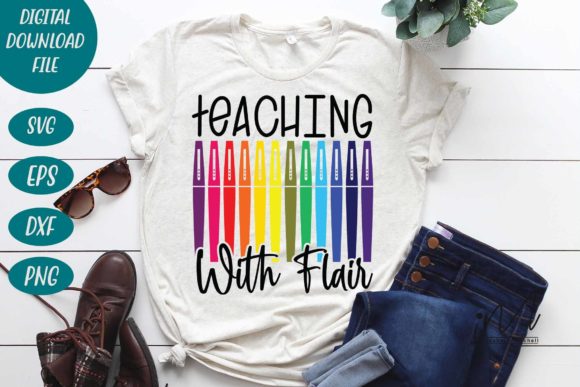
Teaching with Flair SVG: A Designer’s Review
As a designer who spends half my life digitizing and the other half stitching, I have learned to look past the flashy preview images. When I downloaded Teaching with Flair Svg, I wasn’t just looking for a cute phrase; I was evaluating its viability for real-world production. In the world of Crafts and digital Graphics, there is a vast difference between a design that looks good on a screen and one that holds up under the needle. This review breaks down how this specific asset performs when moved from a vector file to a tangible, stitched product.
First Impressions and Visual Personality
The immediate appeal of Teaching with Flair Svg lies in its balanced typography. The quote ” Teaching With Flair ” suggests confidence and style, which is exactly what modern educators want to project. Visually, the layout feels open and airy. For an embroidery designer, this is crucial. Dense, cluttered designs often turn into messy blobs of thread once stitched out, especially on textured fabrics. This design, however, offers clean lines and distinct letterforms.
The mood it creates is professional yet approachable. It does not scream for attention with excessive ornamentation; instead, it relies on strong character shapes. This makes it versatile. It fits naturally into the category of boutique branding or personalized gifts where subtlety is valued over flashiness. When I first opened the file, I noted the scalability. Since you receive formats like SVG, DXF, and EPS, the ability to resize without losing quality is a significant advantage for those of us working across different hoop sizes.
Real-World Application: The Custom Tote Scenario
To truly test a design, you must imagine it on a physical object. I recently worked on a custom order for a local teacher’s appreciation event. The client wanted something durable, stylish, and suitable for daily use. I chose a heavy canvas tote bag as the substrate. This is where Teaching with Flair Svg proved its worth.
Because the design is essentially typographic, it translates beautifully into a satin stitch border or a clean fill stitch interior, depending on the size. On the tote, I opted for a medium-sized placement on the front pocket. The clear spacing between letters ensured that the fabric weave did not interfere with the legibility. Unlike intricate applique design work that requires precise cutting and multiple layers, this SVG allows for a straightforward stitching process. The result was a crisp, professional-looking handmade product that the recipient loved. It didn’t look like a hobbyist experiment; it looked like retail merchandise.
Versatility Across Product Lines
Beyond tote bags, this design shines in several other areas of commercial embroidery:
- Sweatshirt Embroidery: The bold nature of the text stands out well against the fuzzy texture of fleece or cotton blends. It makes for an excellent custom apparel item for faculty lounges or school spirit days.
- Aprons and Kitchen Towels: For teachers who also love cooking or hosting, this adds a personal touch to home goods. The simple lines hold up well even after frequent washing, provided the stabilizer is chosen correctly.
- Patches and Badges: If you are creating an embroidered patch, the clean edges of this SVG allow for tight satin stitching around the perimeter, giving a polished finish that rivals manufactured goods.
Technical Considerations for Stitching
While the design is robust, it is not without its technical demands. As a reviewer, I must point out where caution is needed. The phrase contains specific curves and angles. If you are scaling this down for a small hoop, such as a 4x4 inch area on a baby onesie, you must be wary of stitch density. Tiny lettering can become illegible if the threads merge. I recommend testing the design on scrap fabric first to determine the minimum viable size.
Fabric choice plays a massive role here. On dark fabrics, you will need high-contrast thread colors to ensure the message pops. White or metallic threads often work best for visibility. Conversely, on light fabrics, you have more freedom, but you must ensure your stabilizer is sufficient to prevent puckering. Since this is a text-based design, any distortion in the fabric will be immediately noticeable to the eye. A cut-away stabilizer is usually my go-to for garments that will be washed repeatedly, while tear-away might suffice for decorative items like pillow covers that see less wear.
Navigating Curved Surfaces
Applying Teaching with Flair Svg to curved surfaces like caps requires extra attention. The flat nature of the text can distort if not hooped perfectly. I advise using a cap frame and ensuring the design is centered precisely. The lack of complex shading in this design is actually a benefit here, as it reduces the risk of thread breaks or nesting on the curved crown of a hat.
Business Value and Customer Perception
For Etsy sellers and small shop owners, the perceived value of a product is tied to its execution. A clean, well-stitched design builds customer trust. When a buyer sees Teaching with Flair Svg executed with precision, they associate that quality with your brand. It enhances brand consistency because the design is timeless enough to fit various seasonal collections without looking dated.
Moreover, this design serves as an excellent asset for creating printable mockup previews. Since you receive PNG files alongside the vector formats, you can quickly generate digital listings that show potential customers how the design looks on different backgrounds. This saves time and helps in marketing your design assets effectively. Whether you are selling the finished personalized gift or the digital file itself, the versatility adds to its commercial appeal.
Final Verdict and Practical Advice
In conclusion, Teaching with Flair Svg is a solid addition to any designer’s library. It is not just a graphic; it is a functional tool for creating high-quality embroidered items. However, success depends on your preparation. Always check the license terms before selling finished items or digital products, as rights can vary. Confirm that your software can handle the SVG, DXF, and EPS formats efficiently to adjust colors and sizes as needed.
Before committing to a client project, run a test stitch. Check the tension, inspect the small details for clarity, and compare how it looks on both light and dark materials. If you treat this design with the respect it deserves—by choosing the right stabilizer, thread, and fabric—it will deliver a professional result that enhances your reputation as a skilled craftsperson. It is a reliable, stylish choice for anyone looking to add a touch of personality to their embroidery project.