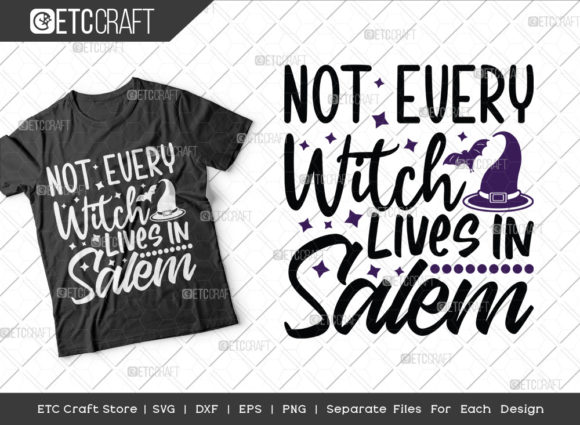
Reviewing the Not Every Witch Lives in Salem SVG for Embroidery
As a designer who has spent countless hours digitizing and stitching out holiday motifs, I approach every new machine embroidery design with a mix of curiosity and skepticism. The market is flooded with seasonal graphics, but few translate well from a flat digital screen to the textured reality of thread and fabric. Recently, I evaluated the Not Every Witch Lives in Salem SVG to determine its viability for real-world craft projects. This isn’t just about downloading a file; it’s about understanding how a witty quote performs when subjected to the mechanical precision of an embroidery hoop.
First Impressions and Visual Personality
The immediate appeal of this design lies in its typographic confidence. Unlike overly ornate Halloween graphics that rely heavily on complex illustrations of cauldrons or broomsticks, this piece leans into modern minimalism. The phrase "Not Every Witch Lives in Salem" carries a playful, empowering tone that resonates with contemporary audiences. From a layout perspective, the balance between the words suggests a design intended for clarity rather than density. For those of us working in Crafts and Graphics, this distinction is crucial. A cluttered design often results in a muddy finished product, whereas this layout promises clean lines and readable text, even at smaller scales.
The mood is lighthearted yet chic, making it versatile beyond traditional spooky decor. It feels appropriate for a boutique clothing line, a personalized gift for a friend who loves autumn aesthetics, or a standout item in an Etsy shop looking to differentiate itself from generic mass-produced goods.
Real-World Application: The Tote Bag Test
To truly gauge the utility of the Not Every Witch Lives in Salem SVG, I visualized it on a heavy canvas tote bag. This is a staple product for many small business owners and hobbyists. Canvas provides a stable, non-stretchy surface that is ideal for maintaining stitch integrity. In this scenario, the design would likely serve as a central focal point. The contrast of bright embroidery thread against natural or black canvas creates high visual impact.
However, the application extends further. Imagine this stitched onto a cozy sweatshirt. Here, the texture of the fleece becomes a factor. The design needs enough spacing between letters to prevent the fabric pile from obscuring the message. If the original file includes varied font weights, the bolder sections will hold up better on textured fabrics like terry cloth or fleece, while thinner strokes might get lost. For a custom apparel project, this means selecting a robust fill stitch or a dense satin stitch for the lettering to ensure durability and readability.
Considerations for Small Hoops and Curved Surfaces
One must exercise caution when applying this design to smaller items, such as baby clothes or caps. While the quote is short, the legibility depends entirely on the size. On a embroidered patch or a baby onesie, the text might need to be scaled down significantly. If the original vector paths are not optimized for small sizes, the tiny serifs or intricate curves in the letters could cause thread breaks or nesting issues during stitching.
For curved surfaces like baseball caps, the distortion inherent in the curvature can stretch the design. A design that looks perfect flat may appear elongated or compressed when stitched on a cap. It is essential to check the aspect ratio and potentially adjust the pull compensation if you have access to the editable source files. Since the product description mentions formats like SVG, DXF, EPS, and PNG, users with digitizing software can manipulate these vectors to optimize them for specific hoop size constraints before converting them into machine-readable embroidery files.
Technical Performance and Stitch Quality
The transition from a cut file to an embroidery file requires careful attention to detail. The provided formats indicate this is primarily a vector graphic intended for cutting machines or digital printing. To use it for embroidery, one must digitize it or convert it using specialized software. This step is where the quality of the final finished product is determined.
When digitizing this quote, pay close attention to stitch density. Overly dense stitching on thin fabric can cause puckering, while too little density may leave gaps where the background fabric shows through unintentionally. For a professional look on a tote bag design or sweatshirt embroidery, I recommend using a combination of satin stitches for the main text and running stitches for any delicate decorative elements. Always test the design on scrap fabric first. This allows you to verify thread tension and color contrast without risking your final garment.
Thread color selection plays a pivotal role in the success of this design. Classic Halloween palettes—orange, black, purple—are obvious choices, but consider modern twists like sage green, mustard yellow, or slate blue for a more subdued, trendy aesthetic. Testing the design in black and white mockups can help identify potential visibility issues before you thread the machine.
Commercial Viability and Brand Consistency
For Etsy sellers and craft business owners, the commercial appeal of this design is strong. It taps into the popular "witchy" aesthetic without being overly niche or aggressive. It fits seamlessly into a brand identity that values humor, empowerment, and seasonal charm. When used in commercial embroidery projects, consistency is key. Ensure that the style of this design matches your other offerings. If your shop specializes in delicate, floral embroidery, this bold typographic piece might feel out of place unless curated carefully within a specific Halloween collection.
Moreover, the versatility of the file formats—SVG, DXF, EPS, PNG—allows for multi-channel marketing. You can use the PNG for printable mockups on your website, showing customers how the design looks on different products. The SVG and DXF files can be used for creating matching vinyl decals or paper crafts, expanding your product line beyond embroidery. This cross-platform utility adds significant value for digital product sellers and creative entrepreneurs.
Final Practical Notes for Makers
Before launching this design in your small shop product lineup, consider the following:
- Stabilizer Choice: Use a cut-away stabilizer for stretchy fabrics like sweatshirts to prevent distortion over time. For woven fabrics like tote bags, a tear-away may suffice.
- Fabric Texture: Avoid using this design on highly textured fabrics like bouclé or thick chenille unless you increase the stitch density significantly.
- Licensing Check: Always confirm the licensing terms associated with the download. Ensure you have the right to use the design for commercial purposes if you intend to sell the handmade product.
- Washability: If creating items like kitchen towel or aprons that require frequent washing, ensure the thread type is durable and colorfast.
In conclusion, the Not Every Witch Lives in Salem SVG is a promising asset for designers willing to put in the digitizing work. It offers a blend of humor and style that appeals to a broad audience. With proper technical preparation and thoughtful material selection, it can elevate a simple piece of fabric into a cherished personalized gift or a best-selling item in your holiday inventory.